
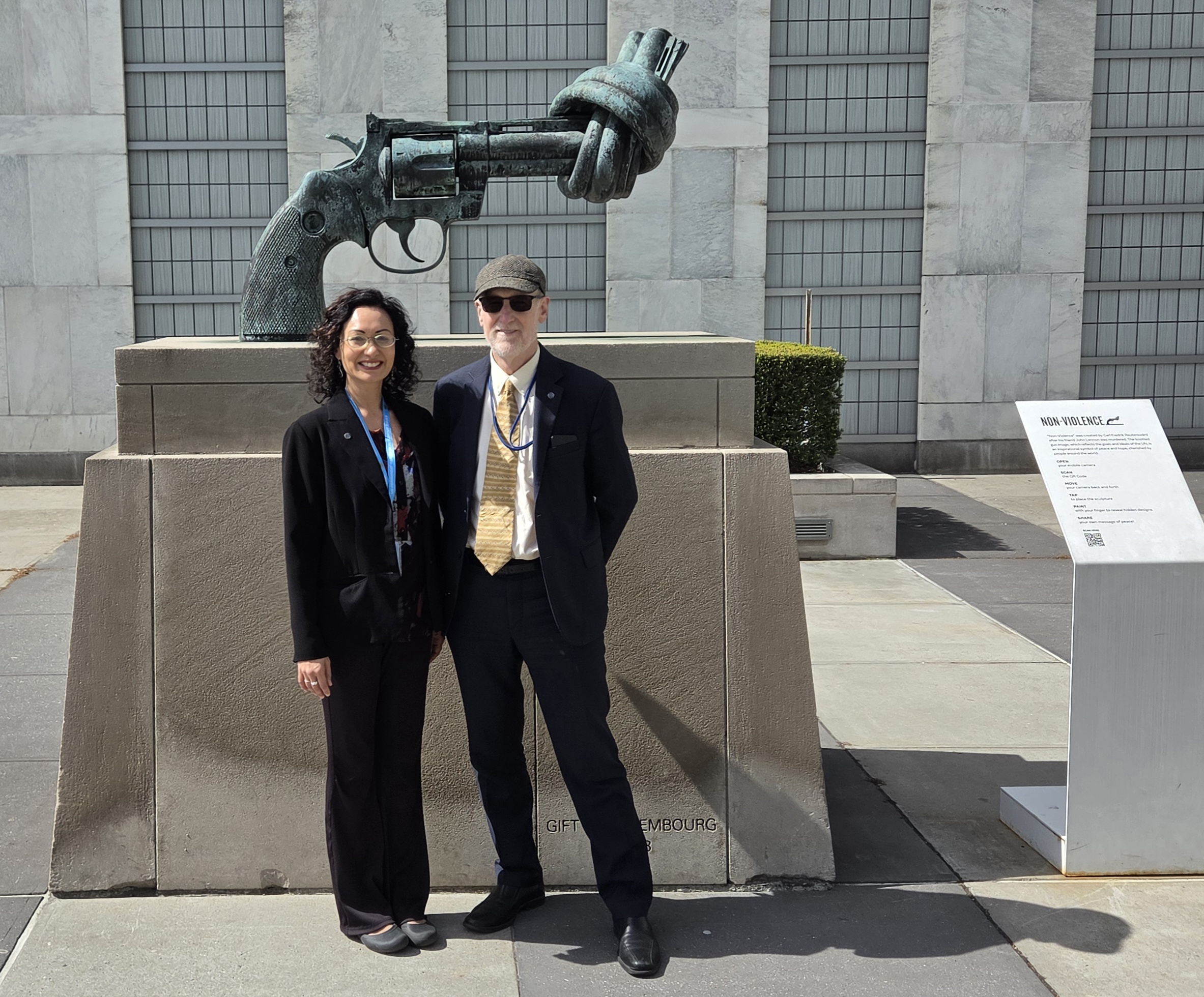
Field Notes from IPPNW GLO’s leaders in New York
The following report reflects observations and highlights shared by our director, Jienna Foster, and policy director, Chuck Johnson, who are attending the 2026 NPT Review Conference in New York.
Day 0 – Sunday, April 26 | Civil Society Sets the Tone
The unofficial opening of the Review Conference week began with a demonstration in front of the New York Public Library, organized by Campaign for Peace, Disarmament and Common Security (CPDCS), Advocates for a Peaceful World, and Nihon Hidankyo. Delegations from Japan were strongly represented, and the gathering opened with presentations by Buddhist monks, peace groups, and civil society advocates before transforming into a peaceful march toward the United Nations. Chants of “No more Hiroshima! No more Nagasaki! No more Hibakusha! No More War!” filled the streets, a deeply moving and inspiring start to the week.
The afternoon brought together a rich and substantive gathering of civil society organizations for a three-panel forum that set the intellectual and moral tone for the days ahead, called “Civil Society Forum: Tectonic Geopolitical Changes: Which Way to Peace & a Nuclear Weapon-Free World?”
- The opening panel, “Nuclear Powers, the Arms Race, and Proliferation” carried an unmistakable emotional weight. A representative of Nihon Hidankyo, who may be one of the youngest surviving hibakusha, recounted the story of his village, located just 4 kilometers outside of Hiroshima at the time of the bombing. He was three months in his mother’s womb. His account of how his father’s life was taken so that he could live, and how he carries that truth with him every day, left no one in the room unmoved. The panel also addressed the widening global arms race: one speaker noted that the UK is expected to increase its defense budget from its current level to 2.5%, then 3%, and eventually toward the 5% GDP level recommended to NATO by the US, while budgets for essential social services continue to shrink. It was a pattern echoed across many countries. Another panelist noted that governments collectively spend 200 billion dollars per year on nuclear weapons, while the global economy suffers from deeply misaligned spending priorities. New nuclear arrangements being struck in Europe, it was argued, are being made in disregard of international law. One speaker offered a thought-provoking observation: that the current US administration may have inadvertently created an opening, by forcing European countries to decide whether they will continue hosting US nuclear weapons on their territories, effectively turning those countries into targets.
The panel closed with a call from a former Mayor of Hiroshima for Nuclear Abolition by 2045, the 100th anniversary of the bombings, as both a global slogan and a concrete goal. While some felt the timeline was too distant, there is also real value in anchoring the movement to a specific, historically resonant date.
- The second panel, Challenging Nuclear Deterrence, examined the moral and strategic failures of nuclear deterrence. Austria reaffirmed its strong commitment to the NPT process and its work on the humanitarian impacts of nuclear weapons, including through an Austria-sponsored conference whose findings were circulated to states parties of the Treaty on the Prohibition of Nuclear Weapons (TPNW). Multiple voices made the case that deterrence is not only “dizzyingly insane and immoral” in its logic, but that it simply doesn’t work. Sweden’s experience was offered as a striking case study: before February 24, 2022, Sweden had maintained nearly 200 years of neutrality. Since then, it has joined NATO, edging step by step toward full compliance with NATO nuclear policy. Whether a future government will restore a peace-oriented foreign policy remains an open question, but one that many in Sweden are actively pressing.
On a more hopeful note, one speaker reminded the room of what the disarmament movement has already achieved. Across generational and gender lines, public opinion is firmly on the side of nuclear abolition. In the United States, support for nuclear weapons shifted from positive to negative in the polls following the Cuban Missile Crisis in the 1960s, and has never recovered. Globally, more than 99 countries have signed the TPNW, demonstrating that the political majority is clear. The remaining challenge is winning a small number of critical political battles.
- The final panel, “Where We Go From Here”, turned to strategy and hope. ICAN highlighted meaningful progress: 56 former government ministers have signed a letter urging their governments to support the TPNW, over 1,400 parliamentarians have taken a stand, and divestment campaigns, from Scotland to Japan, are putting real pressure on banks, universities, and institutions.
A representative from Korea offered a thorough account of the nuclear dynamics on the Korean peninsula, calling for an official end to the Korean War as a necessary first step, noting that the United States has been holding this back as a bargaining chip, which she described, plainly and correctly, as backwards.
The psychological shift prompted by recent global events was also addressed: people are taking greater personal responsibility for the world they will leave to their children, and the disarmament movement must seize this moment. In the United States, Back from the Brink now counts around 200 municipalities and 70 members of Congress as supporters, a quietly remarkable achievement.
The session ended with calls for the Japanese government to return to its constitutional commitment to non-nuclear principles, and for sustained grassroots pressure on elected officials in the US and beyond. As one speaker put it: that is the citizen activism that keeps politicians accountable to the people they represent.
Day 1 – Monday, April 27 | The Conference Opens
The formal opening of the NPT Review Conference was attended alongside many colleagues from IPPNW and allied organizations, and the tone was a notable contrast to the energy of the previous day’s civil society gatherings. Opening statements largely reprised positions that have been heard since the 1980s. One early flash point: the United States “strongly opposed” the nomination of Iran as one of more than 30 vice-presidents of the conference, with support from Australia and the UAE, and expressions of “concern” from the UK, Germany, and France. Iran responded firmly but with composure, and Russia argued that such objections should not be allowed to obstruct the review process. It was, as one observer noted, not a great start, particularly given the irony of a state with the world’s largest nuclear arsenal objecting to another state’s procedural role on grounds of NPT compliance. After a few opening statements, the hall gradually emptied as delegations settled in for what will be a long series of national positions.
Inspiring and concrete conversations were taking place as well at the side events:
- Fossil Fuels and a Nuclear-Free Future: A side event on the links between fossil fuel dependency and nuclear risk drew several IPPNW colleagues and featured a presentation from our team. Many of the speakers were participating simultaneously from Santa Marta, Colombia, where the inaugural Conference on Transitioning Away from Fossil Fuels was underway, a joint initiative of the Colombian and Dutch governments notable for its more inclusive approach to civil society participation, including organizations without ECOSOC consultative status.
- A separate side event, organized by UNIDIR, examined the expanding role of nuclear energy across the Middle East. The report presented was notably balanced, acknowledging both the appeal and the risks of civilian nuclear programs in the region. Speakers raised serious concerns: nuclear facilities located in active conflict zones present grave dangers; the question of nuclear waste management and its vulnerability to attack went largely unanswered; and the enormous financial and time investment required, exemplified by the UAE’s 12-year, tens-of-billions-of-dollar program to build four reactors, is simply beyond the reach of most countries in the region. The case for faster, cheaper renewable alternatives remains compelling and, as yet, insufficiently heard in these discussions.
Further updates will follow as the Review Conference continues through the week.