
Each year, the World Health Assembly is not just a series of diplomatic meetings. For IPPNW in 2026, WHA79 also served as a platform to assert a fundamental truth: peace is not merely a political goal, but a prerequisite for public health.
From the halls of the United Nations in Geneva to multiple events from breakfast to late evening, IPPNW representatives ensured that the link between the threat of nuclear war and its impact on the planet remained impossible to ignore.
The Call to Action for Health Professionals
WHA79 aimed to move past abstract policy debates to focus on the urgent realities faced by health professionals. Stella Ziegler, our very own IPPNW Board Member, echoed this urgency at Médecins Sans Frontières (MSF) during a side event addressing the triad of peace, health, and climate. She offered a counter-narrative to the prevailing gloom by reminding the audience that while the challenges are immense, the younger generation of health workers is rising to the occasion. Her message was clear and provocative: for those on the front lines, silence in the face of suffering can be more dangerous than speaking out.
The Cost of Nuclear Conflict on the Climate
The intersection of war and the environment took center stage when IPPNW member Andy Haines presented at an official WHO side event sponsored by Switzerland and Oman. Focusing on the devastating climate impacts of a nuclear war, he drew on rigorous data from the British Medical Journal and The Lancet to illustrate the catastrophic consequences for global health systems.
His presentation reinforced the vital mission of the Global Peace and Health Initiative (GPHI), demonstrating that protecting health resources in turbulent times is not just humanitarian aid, it’s a strategic necessity for planetary survival. The message was clear: the health consequences of nuclear conflict extend far beyond the immediate blast zone, threatening the climate systems that sustain life globally.
Bridging the Gap Between Policy and Practice
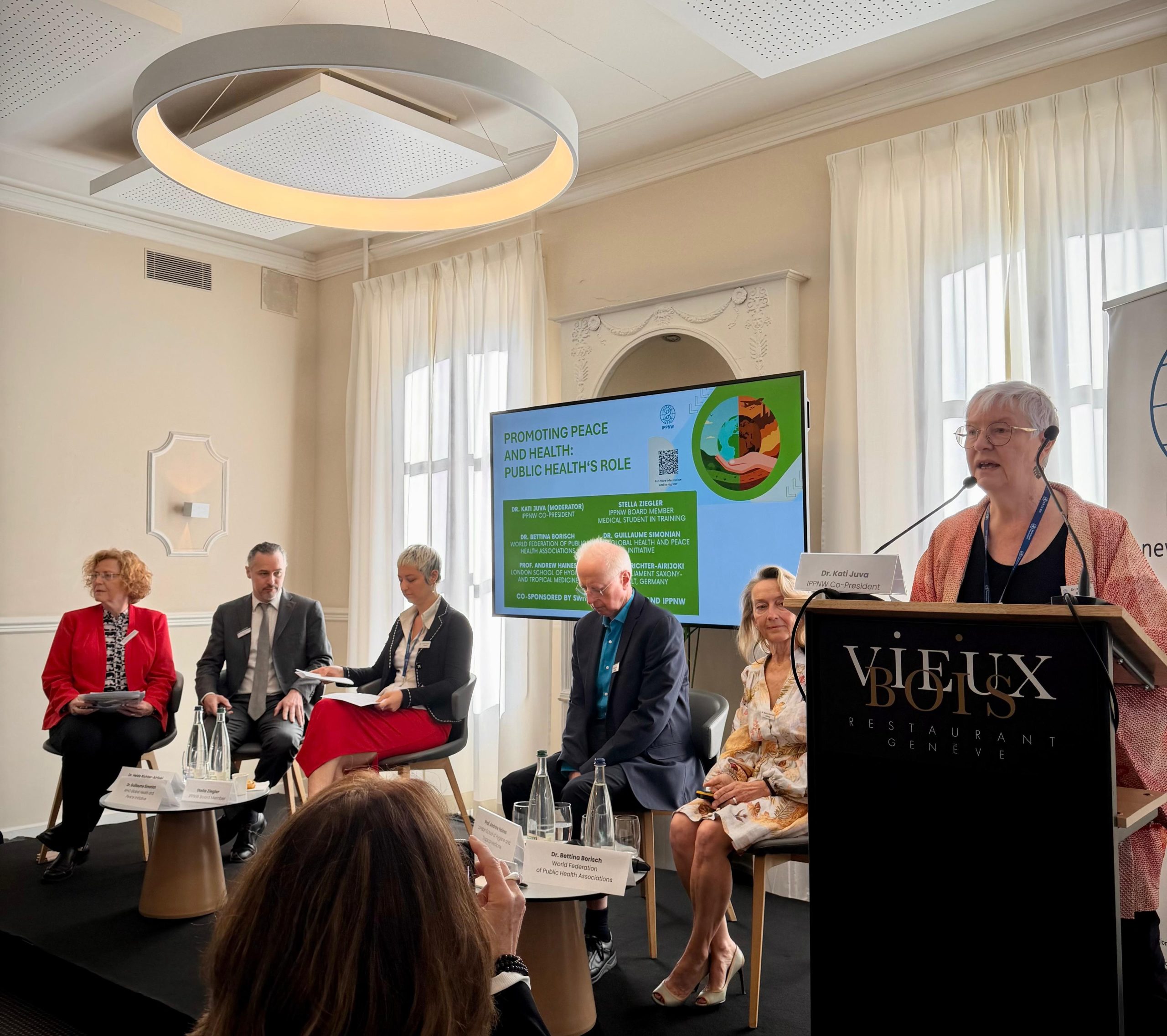
The energy culminated in a breakfast side event organized by IPPNW on the last day of WHA79: a packed gathering at the Vieux-Bois restaurant, located just steps from the UN gates. Despite the early hour, the room was filled with engaged delegates, policymakers, students and health professionals.
Moderated by IPPNW Co-Chair Kati Juva, the panel dismantled the traditional view of war as an inevitable political outcome. Instead, speakers framed violent conflict as a preventable determinant of ill health—one that requires awareness, education, and decisive action.
The panel featured a powerhouse lineup of experts:
- Heide Richter-Airijoki, Member of the State Parliament of Saxony-Anhalt, Germany.
- Bettina Borisch, representing the World Federation of Public Health Associations.
- Guillaume Simonian from the WHO’s Global Health and Peace Initiative.
- Andy Haines of the London School of Hygiene and Tropical Medicine.
- Stella Ziegler, in Clinical Training and IPPNW Board Member.
Co-sponsored by Switzerland, with Barbara Schedler Fischer, Ambassador for Global Health at the Swiss Federal Office of Public Health (FOPH) taking time to address the room toward the end, the event served as a rallying cry: public health cannot be considered as an afterthought in conflict management. The health perspective on conflicts must take on a more central role, and health consequences must be taken into consideration.
The Path Forward
WHA79 made it clear that the work of IPPNW is more relevant than ever. By connecting the dots between climate change, nuclear risk, and public health, IPPNW is pushing for a world where health professionals are empowered to speak up, where conflict is seen as a preventable health crisis, and where the younger generation leads the charge for a safer, healthier future.
The message from Geneva was simple yet profound: There is no health without peace. Prevention is the only cure.